Luckily there wasn't a strong level of denial and stupidity about the findings. Many countries banded together to verify the science, and act responsibly by figuring out how to greatly decrease the use of the questionable chemicals. It was a case of rational response.
Greater complexity with CO2
In contrast, the questions about global warming have prompted huge levels of disagreement. People who barely know any science are passionate about it, sometimes for and sometimes against. Unlike the earlier climate crisis, the data doesn't seem so clearcut.
There have been fluctuations in climate throughout the history of the planet. The evidence of my lifetime is that my region is warming, and many other regions report the same trend. What is the cause? The growth of cities, change in the atmosphere, pollution - all of those seemed plausible, but that doesn't make them the actual cause.
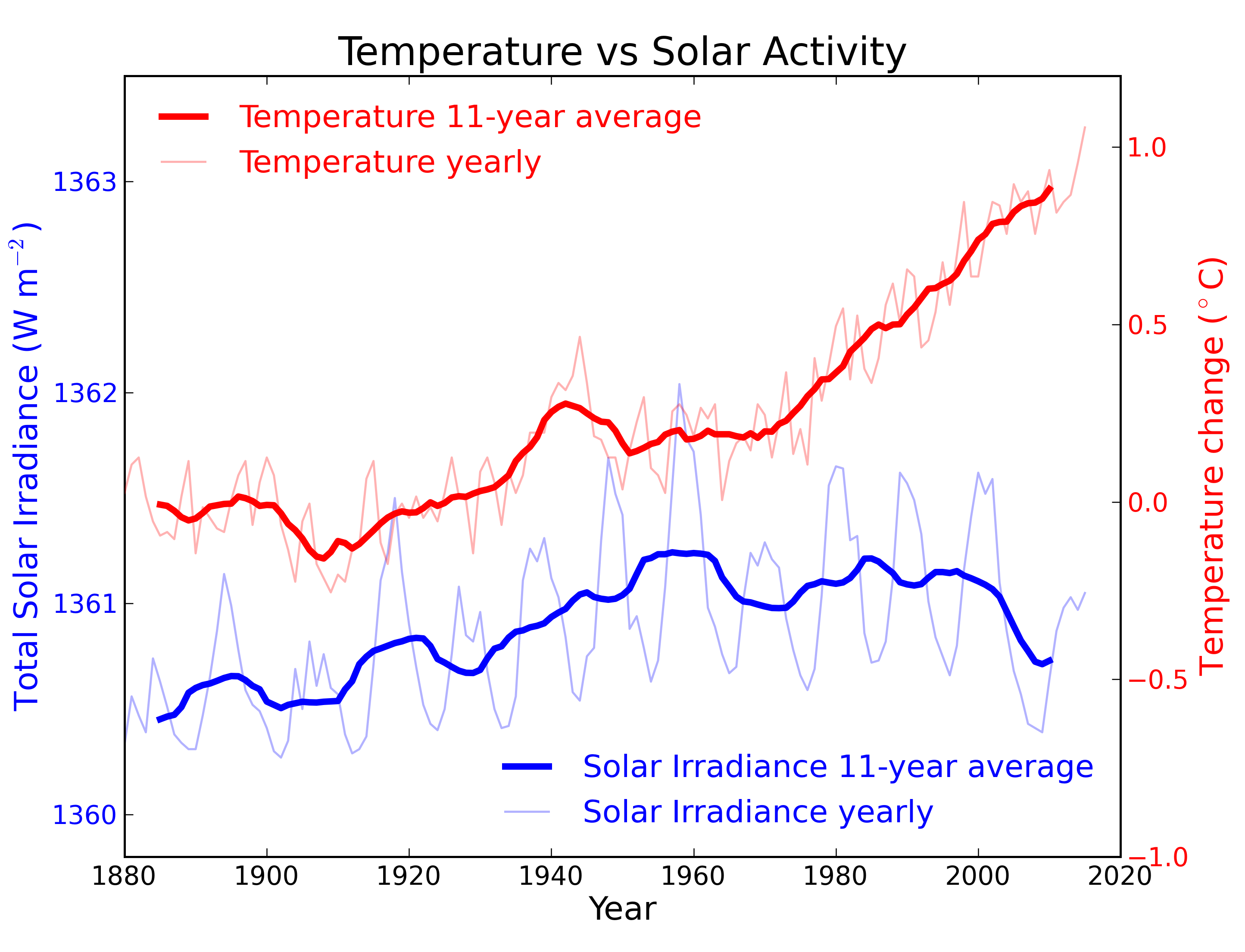
It wasn't until earlier this year that I made a more determined study of the information. By this time I knew of other possible factors, including complex changes in weather patterns (so complex that I never grasped the mechanics of it). There is fairly solid evidence for a warmer period in the medieval period from about 900 - 1300 AD. It's also known (with good scientific data) that the sun can produce greater or lesser amounts of radiation, and that will affect temperatures on Earth. The amount of solar has been running lower than average, which is lucky for us. Had it been average levels, it probably would have added to the warming trend.
Three important FACTS
The warming trends I've seen in my life show on graphs of worldwide average temps:

Image: nasa.gov
There are questions as to how this data is gathered and massaged. I can't answer anything about that except to say that I'm not wrong about the trends I've seen, so I don't believe the earlier springs are a figment of my imagination or the result of shenanigans by scientists.
A second important data point in the increase in CO2 in the atmosphere. This is definitely true, since it would be easy to disprove if it wasn't. No atmospheric sampling has contradicted this finding, so let's accept it as undisputed.
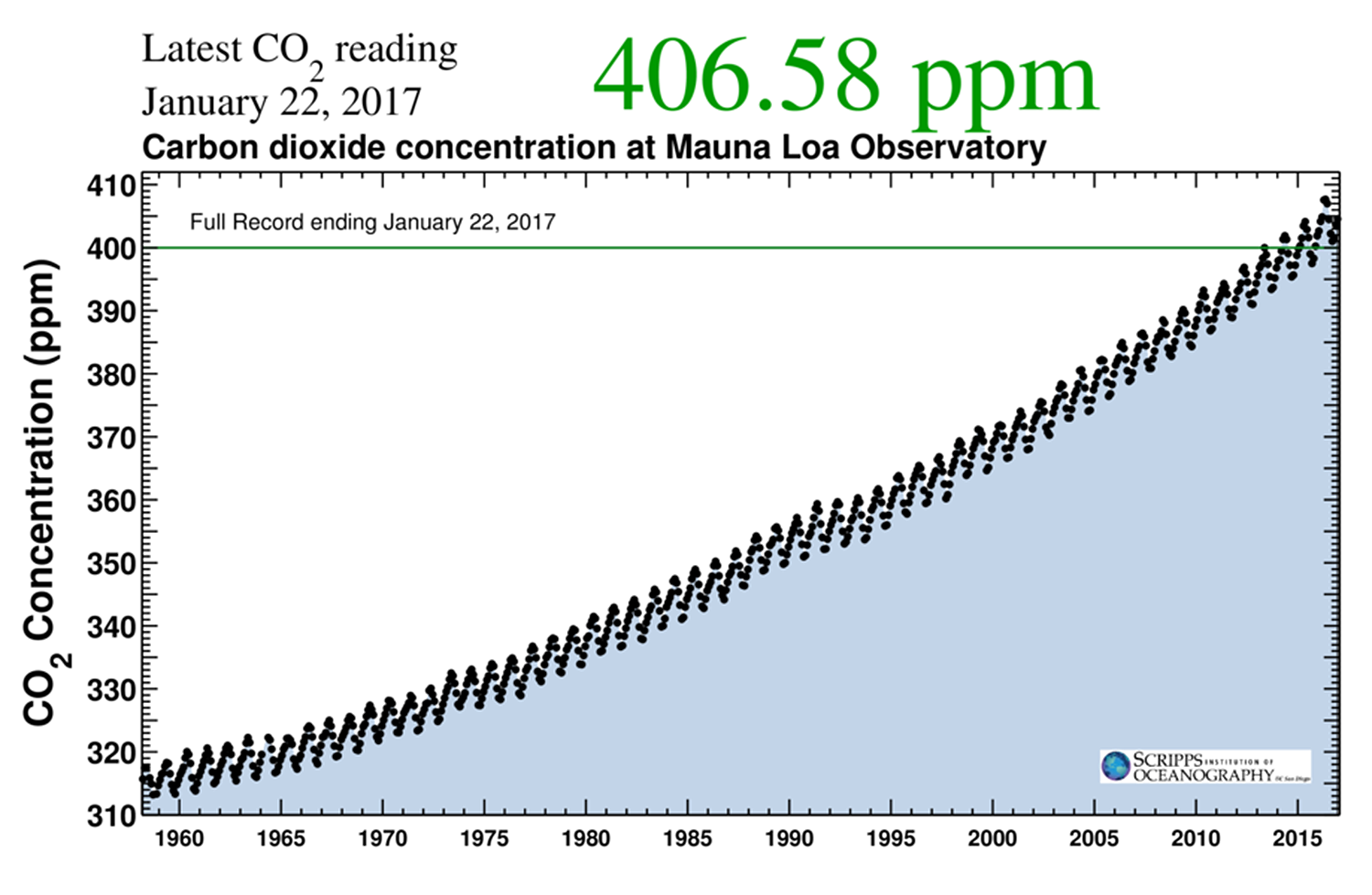
Image: yale.edu
The mechanism of warming is complicated. CO2, water vapor, methane, and other gases are known to trap in heat. We experience this with water vapor (a humid place doesn't cool down at night as readily as a dry locale). Is it also true, as claimed, for CO2 and methane? I think it wouldn't be hard to verify this using standard techniques like mass spectrometry. I'm not a chemist, but this isn't difficult stuff to understand. Different chemical bond absorb and reradiate different wavelengths of light, blah, blah, blah. It's basic, and it's solid.
So, there are three solid points in the argument about global warming.
- the demonstrated increase in global temps
- the demonstrated increase in CO2
- the likely mechanism of CO2 and methane with their known radiation profiles
How to ignore the FACTS
Climate change deniers tend to use these tricks:
- They ignore that world wide temps are rising. This is a data-based fact.
- They ignore that CO2 concentration in the atmosphere is rising. This is also a fact.
- They pretend that climate/CO2 models must be very accurate or all of climate change is nonsense.
Climate deniers are con men ignoring definite scientific data. However, #1 and #2 don't go away because they are liars.
They refuse to consider how harmful even higher levels of CO2 might be, or the bad effects of higher temperatures. Many won't even touch the biggest risk, which is a surge in CO2 when the permafrost melts. They won't face the very real risks. They won't face that it's not going to be possible to turn off the CO2 like you turn off a faucet. As a scientist, I can't pretend that these risks aren't real. Scientists are used to facing facts, whether we like them or not.
And really, are people unhappy with cleaner energy? Why would we be? I don't get why carbon-free energy wouldn't be a goal and something we do as much as feasible. It makes for a better quality of life.
This is the kind of gobbledegock from climate deniers:
And we're about half way to CO2 doubling since pre-industrial times now and what do we have? -- about .9C of warming, suggesting 1.8C for 2X Co2. But the science also states that CO2 constituters 9-26% of the GH-Effect, so it's only 9-26% of 1.8C in this case. The experts are full of beans. They are hoist on their own claims.
Risks, models, and uncertainty
One issue is now very clear to me based on my research. The carbon cycles on the Earth's surface, its oceans and its atmosphere are extremely complex. They are not thoroughly understood and quantified. We don't know how much CO2 a given body of water will absord, or a given forest. We don't know how much CO2 will be released from boggy lands in the northern latitudes as they warm up. These movements of CO2 are very large, and perhaps seem to dwarf the man-made CO2 pollution.
However, don't forget that CO2 in the atmosphere is clearly rising. If there are other huge point sources of CO2 creation on Earth, we would have found them by now and we could work on plugging them. But there aren't. The man-made pollution seems to be the source. To ignore this would be like ignoring a flat tire as the source of that strange noise when you're driving. Some may choose to ignore a clear source, but I don't because I don't ignore evidence that's right in front of me.
Because of the complexity of CO2 cycles on Earth and the interactions related to temperature, I don't trust that the various models of warming are accurate. However, their level of accuracy is not the biggest concern here. It's really only an excuse to ignore what is important, which is the risk of major changes in climate that can have devastating effects on almost all life on the Earth. The amount of possible damage shouldn't be ignored. It is unwise to do so. It definitely behooves real conservatives to be careful, and consider these risks. Real conservatives...
Extras. More on the medieval warming period with a bias against current concerns about warming. Models aren't accurate, but I've noted why that isn't the most important consideration. Trump buries and denies the report from US scientists... because facts don't matter.
The pause in temperature increases may be because the solar radiation was lower than normal due to a quieter solar cycle in the years 2006-20. Temperature versus solar activity clearly shows that temperature isn't currently correlated with higher solar activity. A more up-to-date graph of the solar cycles.

CO2 levels for the past 800,000 years.
Update 2024. I looked up the trend since 1950. Here it is: Warming has been about 1degree C. CO2 + 112 ppm. Methane + 750 ppb.
This is not the best graph I've seen of temperature, CO2, and sunspots, but it's the best I can find right now. From a legit source -- an emeritus physics professor.

Image: L David Roper
Update 5/23/24. I found some cool tools for looking at temperature trends. Temperature trends with global, national, regional, city, and tons of other widgets. Fewer options, but focuses on anomalies.
Update 6/9/2024. Found a link to a site with a large database about climate denial, including who funds it.
Temperature and glacial trends for the last 500 million years. Yes, I'm also very interested in glacial periods.
Good article about the carbon cycle. I'm inspired to estimate how much excess CO2 humans are pumping out. My initial calculation: 20 billion metric tons a year excess. This is based on 1ppm = 7.8 billion metric tons. We are currently increasing CO2 at 2.5 ppm each year. That's just the excess that ends up in the atmosphere. The claim that human production is miniscule compared to the throughput of the natural cycle--I have very strong doubts. I think the natural throughput might be only 5 times the human production. Possibly less.
Here's a German physicist who makes videos to explain science to non-scientists. This is her capsule explanation for how we know human activity is changing the climate. Very clear, and what I tried doing myself.
Temperature increase is 100% due to manmade greenhouse gases. A full analysis.
Parking these two links with CO2 vs. temperature graphs. 400K years, 400 million years CO2 vs. glaciation.
Older webpage but so far the best explainer on the rapid climate changes in the recent glacial and interglacial period. The Younger Dryas et al. Good explanation for how living creatures handled changes in CO2 levels during earth's history.
This graph shows the mean temperature fluctuations for the last 800,000 years. I'm keeping it handy to counter the denialist who claim that it's been much warmer in interglacial periods. No it hasn't-- just a bit warmer than now.

Sources for energy, answering the question about how much coal, oil, natural gas, renewables, etc.