Tuesday, December 18, 2012

Gun follies

We have had so many horrific mass shootings in this country, I'm not sure why the shooting of 20 first-graders would make a difference. After all, 12 were killed in a theater in Aurora, CO, 6 were killed in Tucson, thirteen at Columbine, 37 at Virginia Tech, etc.

So I don't understand the change, but there does seem to be a change. Sen. Joe Manchin,  a blue-dog Democrat from gun-toting West Virginia, wants to sit down with Sen. Dianne Feinstein and figure out some workable gun controls that will prevent this from happening again. He is shocked by this killing spree. I'm not, but I've been watching the trends, and this seems of the same piece.

Bob McDonnell, governor of Virginia, plugs the most common gun supporter solution, which is that we need to protect ourselves by having more guns, such as guns in schools. I totally agree with this. We need guns in our high schools, middle schools, grade schools, nursery schools, maternity wards, and Lamaze classes.

The NRA has kept quiet, but finally announced that they will have a press conference where they'll present "meaningful contributions." Great news, except that they've scheduled the conference for Friday, December 21. Maybe it'll be in the afternoon, right before the long Christmas holiday weekend.

I can think of two reasons that the NRA would schedule for that time:
  1. They are going to say something that will anger their usual supporters.
  2. They aren't going to say anything to anger their usual supporters. 
I don't have much (or any?) respect for the NRA, so my bet is on #2. They'll just retread the usual talking points such as more concealed-carry, more enforcement of current laws, blah, blah, blah.

I've been for a less violent society and reasonable restraint in the sale and use of guns, but I've never seen a way to get there. Mandatory safety procedures (that is, laws) have consistently lost to gun rights forces. Compare this to the effective curbs on drunk-driving, both legal and social.

My response has been largely to give up the fight. I choose not to mount vain attempts to convince my fellow citizens to adopt values they clearly reject. I just quietly disagree and bear it, taking the bad along with the good in my country.

Maybe I shouldn't have given up, and there will be real change now. That's what happened after Timothy McVeigh (from my region of New York) blew up the federal building in Oklahoma. Perhaps it was because of the children killed there too.

Maybe in this country, you can kill any number of adults, college students, and high schoolers, and we won't change. But we will start to think about it when our tykes die. I'm sorry, but that is just dumb. I can't wrap my head around the idiocy of it. In future posts, I might comment again, but I might not. I had truly given up, and it's hard for me to change on a dime.

McDonnell's plan for Va kindergartens
Image: shellgunning.com


Update 12/19/12. I hope that readers don't find this post too callous. I'm not uncaring about the lives lost that can't be replaced, the lost children/brothers/sisters/mothers and everything they would have done with their lives. But I also always see the bigger picture and value honest, uncensored discussions of our human condition and ways to improve it.

Second update 12/18/12. Per the Wall Street Journal:
"Many gun-control advocates, including New York City Mayor Michael Bloomberg, have charged that the group has contributed to a regulatory climate of easy gun access that makes such shootings more likely."
I agree that the NRA has contributed to the atmosphere that makes these mass shootings more likely. Pro-gun groups protest that's unfair to them. I may post evidence for my belief.

Here is the NRA's statement. It is short and worth a look so that you have it straight from the source.
 

Sunday, December 16, 2012

The high price of taxes in GOP fairy land

Boehner is finally just barely admitting that taxes are going up. His latest offer allegedly supports tax rate increases on those with incomes over $1 million. But, for his agreement, Boehner also requires cuts in the big entitlement programs (SS, Medicare, Medicaid).

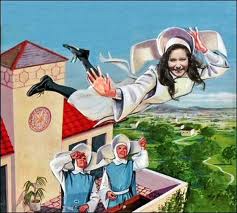
Boehner is still is living in the alternative reality where tax increases might not happen, so he needs a huge payoff to actually allow the tax increases. Meanwhile in the real world, everyone else knows that the tax increases are coming. It's already in the law, and it doesn't require anyone's permission, no more than rain needs permission to hit the ground after it starts falling.


Nuns can fly, but taxes can't rise, in GOP land
Image:zaiusnation.blogspot.com


I almost feel sorry for Boehner because he's in a ridiculous position. He has to try to conjure something out of nothing. The 'nothing' here is the GOP's ability to prevent tax increases, which I keep saying is non-existent. Yes, the GOP has NO CHANCE to prevent these tax increases.

I don't know how large I have to type this information to get the GOP to wake up to this reality. Nothing seems to work. Various GOP congressmen talk about how they've been suckered into raising tax before for spending cuts that never materialize. Sure, my GOP friends, don't ever vote that way again. But realize that you're not being asked for your vote on this. It's coming with no vote needed.

Some Republicans are trying to get their colleagues to consider bills that will extend the tax cuts for some (such as the under-$250,000 crowd), but to no avail yet.  Actually, maybe it's one lonely Republican, Tom Cole (R-OK).

Boy, it's going to be fun watching the GOP when these inevitable tax increases hit. We should have a stopwatch (or calendar) on them to see when the denial finally ends. Maybe the heads of half the GOP will explode.

As they used to say on the countdowns, T minus 15 days and still no realism in sight for the vast majority of Republicans.

Update 12/26/12. Here is evidence of what I surmised, that the GOP didn't understand the inevitability of tax increases. According to a Wall Street Journal insider article, Boehner asked what he gets for agreeing to a $800 billion revenue increase. Obama's reported response:
"You get nothing. I get that for free."
That is harsh, but it's the truth. If Boehner expected any major concession, it shows that he didn't understand the negotiating positions. It's no wonder that they couldn't reach a deal with one party blind to the lay of the land.

Friday, December 14, 2012

Values and judgment: Judging Scalia, judging tradition

Antonin Scalia is in trouble again with liberals and the media over his viewpoints. This happens fairly often, but with little effect on the offender or the offending behavior. Scalia, with a lifetime appointment to the US Supreme Court, doesn't have to change. No amount of anger, demonstration, fury, or criticism will dislodge him if he doesn't want to go. Besides, he seems to love the attention and the fight.

This is the latest fracas: on Monday, Scalia spoke at Princeton. Unsurprisingly, he defended his support of laws against sodomy. He defended his comparison of laws against sodomy to laws against murder. That's expected. However, he unnecessarily twisted the knife when he added:
"I'm surprised you weren't persuaded."
Hey, Justice Scalia, a lot of people have opinions that differ from yours. That doesn't make them stupid or contemptible, so don't treat them that way.

Many people dissent
Image: amazon.com


Tradition vs. Change
Aside from Scalia's atrocious manners (and he's not alone--there are way too many nasty, screeching liberals too), there is a huge question on how we respond to our traditional moral teachings. To gain some perspective, let's look at a case of conflict between tradition and change.

The Christian Example
Christianity had a major problem back in the first century. Did adherents have to follow all the laws of Judaism? On one hand, the laws had made the Jewish people keenly aware of right and wrong, and they endeavored to live in ways that were deeply virtuous. On the other hand, the laws were crazy in their extent. Not only was there circumcision with prayers, etc., but there was a huge number of dietary laws, marriage laws, maybe just about any law you could imagine. This was offputting to people who were interested in living virtuously as God intended, because it strained belief that God intended so many strictures for everyone, not just for the high priests.

St. Paul probably saved Christianity by giving adherents a pass on the old laws, which he deemed to be superseded by the new laws, which were a new covenant with God.

So there's a precedent for looking at your laws (moral rules), and chucking them when they don't make sense anymore. It certainly didn't turn Christianity into a shameless, vile religion that led people into evil ways. Christianity has generally been a force for benevolence to mankind, just as Judaism was and is.

 Image: todayinheritagehistory.wordpress.com

America questions
Now we in the US are in a similar process of questioning some of our traditional morals. Specifically, are homosexual relationships immoral? Can we, like the early Christian founders, examine the laws and judge their merits?

I think we can and should. There are a lot of sources for our moral laws, and many of them are specific customs. The permission of a father or brother used to be required to get married. Was it really a moral necessity, or just a custom? How do you answer such a question? Furthermore, what are the implications of asking such a question?

There are typically two ways to answer the question. One way is to appeal to an established authority, such as custom, religion, or an authority figure. Another is to test the action in a moral system such as the Golden Rule or Kant's categorical imperative.

The Advantages and Problems with a Moral Authority
It's interesting that there is a method other than appealing to authority. For many people, the authority is the final word, and the only safeguard from a moral free-for-all. However, the problem there is that people strenuously disagree on who or what is an accepted authority. Having an acceptable alternative, such as a test by way of a moral system, solves this problem to a certain extent, but many find it an affront to the authority they deeply respect.

Based on what I know of the American founders (admittedly just high school history), they were probably more comfortable with testing within a moral system. Political philosophers such as Locke were developing ideas of government based not on authoritarian justifications, but on consent of the governed. John Stuart Mill and Immanuel Kant are the two philosophers who have tried to develop systems for testing moral precepts that didn't depend on a moral authority. They haven't been completely successful, but that's true for all the other moral philosophies too.

I don't think we'll ever have a perfect moral system. I prefer a non-religiously-based moral system, but that is a preference that reflects my values, not a demonstrably superior position. As I've written before, there aren't absolutes when it comes to values, judgment, and morals.

 Image: irregulartimes.com

Extra. An earlier gotcha moment for Scalia.

Thursday, December 13, 2012

Short: Putting it to Scalia

I'm working on a longer post about why Supreme Court Justice Antonin Scalia is wrong in his judicial attacks on homosexuality. In the meantime, I want to skewer him on his argumentation. Let me paraphrase:
If we cannot have moral feelings against basketball, can we have it against murder?
I hope I've just reduced Scalia's argument to absurdity. That was easy.

Of course, basketball isn't as bad as this...
Image: justpiper.com

Wednesday, December 12, 2012

Revisiting the mortgage crisis

Blaming the other side for the mortgage crisis is an ongoing game, though at a lower pitch than before. A newly published economic study is again focusing attention on the causes, though the study fails to look at the whole picture.

The good thing about this study is that it's gotten people commenting again. That's given me the chance to learn more. This post was my gateway to looking at the issue again, and deserves a mention. However, it is also too narrow in scope-- it focuses only on the thesis that banks should have priced risk better, and it's not the fault of CRA that they didn't.

The real feast is in the comment page of this brief post. Especially worthwhile are the comments of Steve Sailer, a journalist/blogger who frequently writes about the preferable outcomes and values of white American culture and provides evidence to back it up. To some, that makes him a racist. Maybe he is, but he still has points that are important to consider.

These are some facts (or possible facts) that I learned from his comments:
  1. The Clinton administration "threatened" Countrywide, a mortgage lender, with heavy regulatory pressure if they didn't lend to more low-income borrowers. 
  2. The regulatory environment favored robust low-income lending when mergers were evaluated for approval. Bankers who were sceptical were effectively weeded out.
  3. Steve Sailer isn't an ideologue who is trying to put all the blame on one quarter.
These comments discuss how CRA and similar policies changed mortgage lending practices to make it easier for low-income and minority borrowers to get home loans. These changes are part, but only part, of the huge developments in mortgage lending, including all kinds of new mortgages and the packaging of mortgages as securities.

It is clear that the Democrats liked the outcome of more minorities getting home loans. Republicans liked it too, and "the ownership society" became one of their slogans. It was good that more minorities and lower-income people were able to become homeowners and enjoy those benefits such as building equity.

What is unfair is how some conservatives are now trying to place all the blame on Democrats and their policies. This is a lie. Though there definitely was pressure from Democrats, including the Clinton administration, to increase minority lending, it is hardly the largest cause of the crisis. A fair accounting looks at many factors, not just CRA, Fannie, Freddie, and what Dems did. This was only part of the action, not even close to the whole rotten edifice.

We should be trying to figure out what policies were good or neutral, while identifying others that were problematic. This applies to all areas, including low-income lending, underwriting standards, rating agencies, and securitization. However, we may not be able sort the good practices from the bad because the horribly overheated housing market confounded everything.

Most important, let's all learn some lessons from this horrible crisis. And please, let's not use it just to bash "the other side."

Untold suffering
Image: washingpost.com


Update 1/24/14. "The Dems caused it" is still a favorite claim. So in arguing it yet again, I found this great article about how the Bush administration and the Supreme Court hampered states from trying to prevent the crisis they foresaw. Also, here's a good exchange between two data heavyweights, though there's no resolution of their differences. [Sadly, those comments are no longer available.]

Let me say clearly: Dems made this worse, Republicans made this worse, Fannie and Freddie made this worse, but most of all it was the Wall Street banks. Anyone who ignores some of the players is lying and it's probably for political reasons.

Update 3/27/14. Still a favorite claim. I tried to find out how 'liar loans' [stated income loans] started. I didn't find the answer, but I found this testimony from 2006.

Update 3/28/14. More great testimony here, but don't stop at the title because it's misleading. Follow-up post here.

Monday, December 10, 2012

Voters to government: Do it over

(Prologue: This was written soon after the election. I don't why I didn't publish it then. It seems pretty good to me, with an acerbic viewpoint that's worth reading. Late but still timely.)

Some, who were reluctant to negotiate, are now trying to do it on double-time. Yes, I mean the GOP leadership. That's what happens when you save a year's worth of work for the end of the semester lame-duck session.

Why did the electorate inflict this on our elected officials?

Well, it's not as though the US electorate is a coordinated organism. But there may be some wisdom of crowds here. After all, what are the alternatives to split government? All Dem or all GOP. We collectively said "Spare me." (Well, that's my take. Interpretations differ.)

Image: t.co

Mano a mano negotiations

The negotiations on fiscal cliff are limited to two people--President Obama and Speaker Boehner. Thanks be to God!

The last thing we need is a lot of Congress people thinking they'll have an outsized voice on this. They don't have a special insight into the will of the people, though many of them are claiming to. It's torture watching the Sunday morning talk shows (mercifully shortened here).

Sen. Tom Coburn (R-Oklahoma) says he'd vote to raise taxes if there was significant progress on entitlement reform. It's good higher taxes are on his radar because they're coming no matter how he and the rest of the Senate vote.

Over on CNN, a reality-based Republican (Tom Cole) is sounding sensible because he wants to pass what both sides agree on--keeping the tax rates for the lower 98%. Meanwhile, Marsha Blackburn seems to think she'll have a chance to vote to keep all the tax cuts. She won't.

Despite lingering anger or cluelessness, whispers of rebellion against Boehner subsided (after peaking on Dec. 6). Enough GOP reps have realized that they'll just have to trust him to make the best deal he can. Holding the tax rates on the middle class as hostage isn't going to work since Obama is itching to call that bluff (despite Marsha Blackburn) and see the blame rain down on the GOP.

Boehner still has the threat of shutting down government over the debt ceiling or appropriation bills. Rather, his caucus wields that threat, and they might very well use it if Obama gives them nothing. (If Obama gives nothing, the blame will quickly switch direction to rain on him.) So there is strong incentive on both sides to negotiate.

The biggest problem for the GOP is its pride in not compromising for 99% of four years. That's a hard habit to break. So it's good that they have one designated negotiator to make those hard decisions, and do what the rest of the GOP can't. It shows that there is not always strength in numbers. More particularly, there isn't always wisdom in a crowd.

The Dems kept pretty quiet during the campaign and didn't jinx themselves with the usual moral blather about our duty to [expensively] take care of society's ills. Will they be able to keep quiet when the deal isn't as advantageous as they had hoped as the election returns rolled in? I certainly hope so. The memory of the flogging in 2010 of overreaching Democrats should be fresh enough that they don't need too much of a reminder.

So, I say, let Obama and Boehner hash it out. Run all the rest of the cooks out of the kitchen, close the door, and see what kind of sausage they make. It can't be worse than the freaking awful dreck Congress would serve up if more of them were involved.

Putting their heads together
Image: draftdaysuit.com