Showing posts with label Medicaid. Show all posts

Sunday, August 6, 2017

Quick summary: Repeal FAIL

This is an important issue, but I don't have a bunch of time to spend on it. The Senate failed to repeal and replace Obamacare. McConnell proposed, negotiated, twisted arms, and pulled bills from votes. It was a big embarrassment, so McConnell and the Senate made a last ditch effort TO DO SOMETHING (never a good situation).

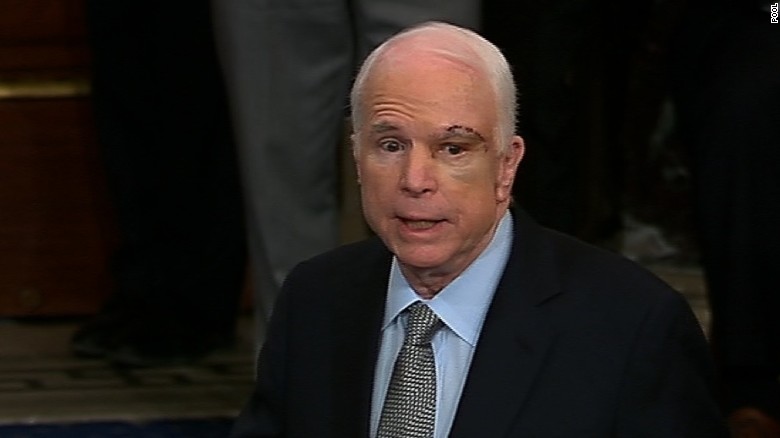
McConnell had the Senate voting on bills or amendments within an hour or so of when their text was released. So much for 'a deliberative body' or not 'ramming it down their throats.' John McCain, with stitches on his left eyebrow and newly diagnosed with brain cancer, flew in from Arizona as a necessary vote to start debate-athon.

Two days later, McCain was one of three GOP senators who killed the effort. Maybe it was doomed anyhow. The conservatives vowed that they needed a fuller repeal, with more taxes gone. They folded pretty quickly. The moderates wanted assurances that Medicaid funding wouldn't disappear--this is a higher priority to senators as state-wide representatives, as I mentioned before.

McConnell promised his colleagues that the bill would go to conference, and their concerns would be addressed in the future. Paul Ryan didn't promise that. What is the promise of a politician like McConnell?

A lot of senators who were leery voted for the measure based on these assurances, but McCain didn't, and that was the killing stroke.

Image: kitv.com

Extras. What next? Maybe some bipartisan negotiation.


Saturday, July 1, 2017

Replacing Obamacare is harder than they thought

No surprise about the complexity of the task. The House just barely passed an Obamacare repeal-and-replacement. Now the Senate is trying to do it, and having even more trouble. While the House has some moderate Republicans, every moderate Republican in the Senate has a critical vote. Three defections to 'no' will scuttle the ACA replacement, so the margins in the Senate are even tighter. Also, each senator represents the whole state, not just the more conservative parts of it. It could be that senators need to be more concerned with Medicaid recipients than their colleagues in the House.

It's fascinating to read in this article what different senators want. Rand Paul and Ben Sasse (he of anti-Trump fame) would support a straight repeal. Is that position for real? Don't they worry about the ensuing chaos if there is no replacement plan?

Sen. Bill Cassidy of Louisiana, someone I wouldn't expect to be a moderate, is holding off on supporting the bill if it removes too much money from Medicaid. Louisiana isn't one of the richest states, so it probably has a fair number of people who have gotten their healthcare through the Medicaid expansion. Cassidy seems loathe to throw them back into healthcare limbo. Some senators, like Rand Paul, don't have such quibbles.

These negotiations will be interesting to watch. A pro-Trump PAC already targeted a senator leaning toward 'no' and already had to drop their pressure tactics. Whether the senators will be able to come together, compromise, and satisfy enough of them is an open question. A cool graphic in this article shows that more senators are concerned with the bill not covering enough versus those concerned with that it won't repeal enough. It leads me to expect a more moderate bill passing the Senate. But we shall see. Failure is certainly possible: only three senators need to decide to be stubborn to sink this bill.

Image: cbsnews.com

Sunday, February 17, 2013

Grand political strategies of our times

Hat tip to commenter Anastasios for this topic. He wrote:
The GOP thinks that they are well-entrenched in the House and time will eventually bring them back into power with a well-timed recession or a major Dem mistake... The Dems acknowledge the mid-term danger but believe the GOP is slowly being throttled to death by demographic and social change, and that by about 2030 the left will have grown strong enough that the dreams of conservatives will be forever dead... In any case, neither side is trying to get things done, but to set agendas for when their expected futures come about. Whatever happens with the sequester and the budget is merely a blip in the sweep of the longer-term strategies they are pursuing... At this point I don't think either party finds it in their interest to minimize problems. [Emphasis added by MP.]
I don't know whose agenda the future will favor, but his point spurred me to think about grand political strategies of the recent past.

 The Permanent Republican Majority

Back in 2001, or even earlier, Karl Rove envisioned a permanent Republican majority. That wasn't so long ago, but I still had to remind myself how it was supposed to come about. In a nutshell, the GOP would build a coalition of reliable, motivated supporters who would vote in larger percentages than the general public. This coalition was conservative (social, fiscal, and foreign policy) with pro-business and evangelicals being in the forefront.

Rove was very solicitous of the concerns of evangelical and conservative groups. But he also needed to make sure that the GOP blind-sided by bread-and-butter concerns, so education and Medicare were also on the radar. I recall reading the Medicare Part D came about because Rove didn't want the Dems to have the lack of medication coverage as an issue.

Of course this dream didn't survive the debacle of the Iraq war, with all lives lost, money borrowed and wasted, and arrogance that it was going well. The dream, already dead, was killed even deader by the financial crisis of 2008. No wonder I had to research to remind myself how 'the permanent Republican majority' was supposed to work.

The Obama plan?

This is much more speculative (meaning I have no data to help me determine either way), but perhaps Obama has a similar plan for a permanent Dem majority. The Dems tend to be favored when turnout is high, which means that they gain the most from turning irregular voters or non-voters into regular voters. Obama's 50 state strategy and local campaign offices that stay open and active through the off-years are aimed at this pool of irregular voters. I think the major drives to sign people up for food stamps and Medicaid also aim to turn irregular voters into regular voters.

If Dems can keep these voters coming to the polls, and sign up even more, they will have an electoral advantage. There's little the GOP is doing to woo these voters away, and they don't have an equivalent pool to tap. Lots of people think the GOP is screwed. So it would seem unless the Dems revert to being their own worst enemies through overreach.

Triangulation

I can't end this reflection without mentioning the Clinton strategy of triangulation. Under this strategy, Clinton negotiated a successful reform of welfare. He also avoided the fate of many old-line Democrats (turned out of office in 1994), and won reelection in 1996. Though it wasn't a 'grand' strategy, it worked well for Bill Clinton. Hillary wasn't so lucky or adept, and the Dems gave the nomination in 2008 to someone friendlier to the traditional left.

Successful planning

I notice that political strategies don't have as long a shelf-life as their supporters hope. I also notice that I can talk about strategies without talking about principles or deeply held values. Of course, deeply held values probably don't have a long shelf-life either as political strategy, or a successful strategy at least.

Deja vu
Image: amazon.com

Friday, February 1, 2013

The absence of coherent Obama criticism

I spend way too much time reading politics on the internet, but it certainly has broadened my thinking. I especially like the comments since there are a wider range of ideas, some wonderfully unfiltered. There are trolls too, but I occasional learn something from them.

One commenter was complaining that there are no Dems criticizing Obama from the right. That's a good point. Where are the Dems who are urging Obama to be more conservative, particularly more fiscally conservative?

I tried to remember any, and I couldn't. So I called my friend Google, who provided only one on-topic link to Dems criticizing Obama, though it's possible that both Google and I overlooked some. Here is the criticism, dating from April 2011:
The push-back has come in recent days from Sens. Kent Conrad (D-N.D.) ... and Joe Manchin (D-W.Va.)... Sen. Mark Pryor (D-Ark.) told constituents during the Easter recess that he would not vote to lift the debt limit without a "real and meaningful commitment to debt reduction."
Perhaps the deal of August 2011 blunted most of the criticism. It's also likely there are fewer moderate and conservative Democrats to apply the pressure. Kent Conrad chose not to run for reelection in 2012, but Joe Manchin and Mark Pryor are still in the Senate. Maybe the Dems have circled the wagons. That would make sense, especially in an election year, if you can get your sprawling party to do it.

Well, something is lost when there isn't criticism from the center. One trollish commenter pointed out that Bill Clinton "should have been criticizing Obama as an irresponsible big spender." You know, I find this believable, especially if it is softened somewhat. I can imagine Clinton thinking that we need to trim some of the federal safety net programs, encouraging people to be more independent, and states to experiment with ways to save money on Medicaid and similar programs. Obama has done the opposite, pushing food stamp and Medicaid sign-ups. (Bush had a program to encourage food stamp sign-ups too.)

So why isn't there more criticism of Obama from the center, or from the right side of the Democratic party? I don't know, but maybe the reasonable criticism was and is drowned out by the over-the-top criticism from outside the party. For example, Gingrich called Obama "the food stamp president," which has unpalatable racial tinges. Others who call Obama "a muslim, ...liar, a socialist, an idiot, a communist, the anti-christ,... evil (list courtesy Google auto-completion) do more damage to themselves and the GOP than to Obama.

Even Romney, who tried to be non-crazy in his charges, couldn't make criticism stick. I think there's a lesson here. You have to be credible in your criticism and not overreach, or you bring doubt onto your whole message. You can't say that Obama has ruined the economy, or it's all his fault the recovery is so weak, without a strong argument to support it. The majority just didn't believe it, and the GOP looked partisan, foolish, and dishonest.

Come on, let's have better quality in Obama criticism. We need it.

Image: teapartytribune.com

Monday, October 8, 2012

Debate 1 reaction

So I made myself watch the entire debate. It wasn't as painful as I was expecting because 1) I was forewarned, 2) I'm well aware of the weaknesses of both candidates, so I'm not surprised to see them.

Romney did the better job covering over his weaknesses during the debate, but he's positioned himself for a lot of uncomfortable followup questions. Obama just needs to sharpen his message and shorten his answers. He also needs to practice with someone other than John Kerry (Mr. Long-Winded Answers). I'm not sure who would be a good stand-in for the short, snappy, but polite answers that Romney gave. No Democrat comes to mind, and that's a sad commentary on the Dems.

Summary
Here is my overall impression of the debate:
  • Romney was strong on the attack, but purposefully vague about his own plans.
  • Obama was moderately good in his defense. Unfortunately, he let his points get lost in too much detail.
Neither is talking specifically about what they would do if elected because this has pitfalls for both. Neither can definitely deliver what the electorate would like to hear--a low-pain transition to fiscal health. So they each hide the respective pain they'd inflict. Since they're both vulnerable, neither is attacking future plans as forcefully as they should be.

Their Weaknesses
Romney is declaring that he won't increase the deficit. He's not even claiming he'll lower the deficit, as a good fiscal conservative should, but only that he won't be worse than Obama on this score.

Yet he has to be vague because he did promise to cut tax rates by 20%, and he'll need to offset that by removing deductions. It looks to me as though his tax rate cut is no longer a promise, and he can probably be nailed on that. However, once he admits it, then the funny math stops being a disadvantage to him, unless of course it costs him the GOP base.

Romney has similar problems with healthcare for people who aren't covered by employers and the future of Medicare. The solutions he proposed in the primaries don't really hold water in the general. He has no answer for the uninsured, and his Medicare proposal is a voucher program that throws seniors into a tough marketplace.

Obama is mealy-mouthed about spending restraint generally. He states that he wants government to help give people opportunities, and most of us know that translates into lots of programs that suck up revenue. He doesn't sound like he's really committed to fiscal restraint.

He overreached in accusing Romney of supporting a $5 trillion dollar tax cut. He could have scored on some very pointed criticism, but now Romney has him sounding like a liar. Obama might have thrown away a big advantage there, but I hope not, because it's a strong, valid point.

Neither candidate had a strong closing statement. Obama was scattered. Romney basically said that another four years of Obama will be awful, but he (Romney) won't be awful. That didn't resonate with the audience (or CNN's focus group), and it's hardly a positive argument for electing him.


Their Strengths
Romney was detailed about what he wanted to do with Medicaid--block grant with 1% increase per year, and give the states the freedom to develop their own programs and priorities. This sounds a lot like what happened with welfare reform, which was successful in turning a huge ongoing headache into a more respectable social program. Notably, it was the only issue where Romney was specific about what he would do.

Romney is making sure he doesn't sound like a heartless robber baron who'll slash education, Medicare, Medicaid, and most government departments. He's back to saying, as he did last fall before the primary heated up, that he'll shrink the government by attrition of government workers, not by sheaths of pink slips.

Overall, Romney sounds like someone who sensibly sees that government has grown too large, and he doesn't want to grow it anymore. Instead, he wants to slim it down gently. This is a good contrast to Obama, who is still building it up.

In Obama's $90 billion for green jobs, Romney has found a great, multi-purposed stick to bash Obama with. Obama wants to spend more on teachers- bam, that $90 billion would pay for a lot of teachers. Want to close a $2 billion loophole for oil companies, bam, you spent 50 years of that money on green jobs.

Obama's strengths are in his explanation of Obamacare and restraint on Medicare spending. His critique about throwing seniors into a nasty healthcare insurance market with only vouchers rang true over and over. Romney had to keep saying that it wouldn't affect today's seniors (but damnation for the rest).


What They Won't Talk About
Neither candidate talked about the sequester, or the "fiscal cliff"--the combination of the sequester and the expiration of tax cuts. This is the hard stuff, the actual cuts, and neither candidate will touch it. Neither is offering even smaller deficits, even though deficits are still running over $1 trillion per year. There are no medals for courage awarded here.

Neither talked much about what they'd do about the Bush tax cuts, even to attack the other. Only one mention of these tax cuts -- amazing. This must be where both are extremely vulnerable, so neither will make it an issue. The moderator should have put them on the spot.

Romney continues to use Simpson-Bowles as another club with which to beat Obama. However, he doesn't embrace S-B. He pretends that he likes it, only he's got a better version. Considering how well I know Simpson-Bowles, I can declare that this is hogwash, otherwise known as craven, corrupt lying on Romney's part. However, I'm happy that Simpson-Bowles continues to be a touchstone. It doesn't die because it's a great plan.

Take-away
I notice that there isn't a lot of video circulating from this debate. There was no knock-out moment. Romney looks like a stronger opponent, but the same weaknesses are still there. Obama will be able to reverse this setback, and Romney has very little he can capitalize on. Romney may have won the debate on style, but it's not a lasting or substantial victory.

That's either Jim Lehrer or the truth.
Image: politicalhumor.about.com
Transcript here.


Thursday, March 22, 2012

Cutting to the bone

When it comes to spending, we have to decide what we want and whether we still want it when we find out how much we'll have to pay for it. That should hold true for government spending too.

Our government and other governments around the world have made a huge mistake decoupling these. They have been aided by willing lenders, or the sheer ability to print money and pushed by constituencies to spend, spend, spend without raising taxes.

Now, I have to remember that a lot of the good things in my life are due to government spending. My paycheck is partially funded by government spending. My kids went to town-funded schools. I drive on public roads. I receive public water and sewer services. I don't fear foreign invasion or plague or bandits because of protections provided by the government. I have to give credit: my government has provided a safe environment for me.

It's important for me to remember this, because when we start cutting government spending, I'm not going to want to cut things that I depend on for my basic safety. I can forego the new highways and high-speed rail but I want some public entity to make sure the bridges don't collapse.

That brings me to the Ryan budget. I've  read that he'll shrink the discretionary spending to 3.75% of GDP from the current level of 12%. This includes military spending, we know the GOP is loathe to cut. This doesn't leave much money for purposes like FEMA, national weather services, FDA, FBI, customs, etc.

It's been hard to figure out whether what the cuts are going to be. According to one analysis (p. 17), Medicaid, SCHIP (children's coverage) and health exchanges support will be cut in half over time. But Ryan's own numbers (p.90) show it dropping just 23% compared to Medicare. The budget outline is also very lean on what discretionary spending is going to cut. It has none of the honesty of Ron Paul's budget where he declares 30% cut to this department and 70% of that department.

So I have no sense that the Ryan budget would preserve the programs I depend on for my safety. That worries me enough, and my health doesn't even depend on Medicaid.

 Not enough funding? -- Collapsed bridge in China

Extra: A conservative analysis (possibly libertarian) of the Ryan budget.

Saturday, January 28, 2012

How bad is Romneycare?


Someone needs to write an honest evaluation of the first health care system in this country that had an individual mandate, meaning you were required by law to have health insurance.

First, it's not the end of the world, or capitalism, nor has it turned Massachusetts into a socialist gulag, a place where the classes wage war, or where bureaucrats rule on every interaction with your doctor. For most people, the healthcare law has barely caused a blip.

Unlike most of my posts, this one won't discuss the financial impacts of Romneycare because I couldn't find clear sources for that information. I can't answer some important questions like how much it costs the state, and whether it has lowered or raised costs. I can report that it's pretty popular in Massachusetts, with 63% approval.

When it was first implemented, I heard complaints where I worked from people who were going without health insurance and now had to buy it. Maybe I should be more sympathetic or more libertarian, but I've been convinced by the economic argument behind the universal requirement. (Here's the capsule version: the pooling of risk doesn't work financially unless low-risk people are required to join the pool. So suck it up for the greater good. That's what we do with taxes.)

Now my 20-something daughter is benefiting from the program. She signed on to the health insurance exchange website, and figured out relatively easily which policy she wants. It's affordable, perhaps subsidized, and she didn't have the anxiety of being turned down. I'm glad she lives in a state that makes it this easy.

Some critics have decried that--what motivation will people have to get good jobs if there's subsidized health insurance? Probably nearly the same motivation as in the standard case (the paycheck, interesting work, self-sufficiency, being useful to society), but without the anxiety that a medical issue can send her into a modern version of the Minotaur's labyrinth.

So how bad is Romneycare? Well, I'm happy with it.

*****************************************************

I'm aware that arguments based on anecdotes aren't reliable. Arguments that ignore fiscal concerns are even worse. It would be good to be able to report the extra savings or expense due to Romneycare, but I couldn't find the statistics. Perhaps that's because it's incredibly hard to sort out the confounding factors, such as unpaid medical bills, higher state costs, costs offset by federal Medicaid payments, a sweetened deal for MA by Medicaid, and personal costs of insurance premiums or patient-paid medical bills. So I'm left with only the anecdotal evidence, which is decidedly pro-Romneycare.


Extras:

Thursday, December 15, 2011

Simpson-Bowles economic plan - WIN

I've written about my support of the Simpson-Bowles plan many times, but I'm finally doing a capsule review as I've done of Obama's, Romney's, and Cain's plans. A debt-reduction commission was created by Obama in early 2010 after Congress after the Republicans in the Senate refused to give a mandate for a commission and guarantee a vote on their recommendations.

The commission was bipartisan with members from the House, Senate, business, and economic experts. They worked from April 2010 until December 2010. In the end, 11 of 18 commission supported the report, with the dissenters split nearly equally between Dems and Repubs. (Thanks, Wikipedia, for this background.)

This plan is actually very readable with all major recommendations put into categories and bullet pointed, like this:
RECOMMENDATION 1.1: CAP DISCRETIONARY SPENDING THROUGH 2020. Hold spending in 2012 equal to or lower than spending in 2011, and return spending to pre-crisis 2008 levels in real terms in 2013. Limit future spending growth to half the projected inflation rate through 2020.

Budget Cuts
Roll back discretionary spending to $688 billion for security and $410 billion for non-security spending. Let agency heads recommend the budget reductions for their department; Congress will not be allowed to micromanage and protect a fiefdom.

Cut congressional and white staffing and budgets by 15%. Reduce federal workforce by attrition. Institute pay freezes and much tighter travel budgets.

Tax Reform
Raise gasoline taxes $.15 a gallon for adequate funding for transportation (currently partially funded through borrowing).

Eliminate most deductions. All dividend and capital gains will be taxed as the same rate as earned income. The commission offered three choices to determine which brackets to establish:
  • If there are no deduction and no credits, the brackets would be 8, 14, and 23%.
  • If there are credits for low-wage workers and their families, the brackets would be 9, 15, and 24%.
  • If there are credits for low-wage workers and somewhat limited deductions for mortgage interest, health insurance, charitable giving, and retirement savings, the brackets would be 12, 22, and 28%.
  • Exemptions would be maintained as is. The standard deduction would become an exemption. A family of four would exempt $26,000 from taxes.
  • Business income tax would be 26 or 28%.

Health Care Spending
  • Freeze doctor reimbursement for 2013 and have a 1% reduction in 2014. 
  • Reform the payment formula. Repeal the longterm care part of ACA (already done). 
  • Institute a simpler, higher deductible higher copay. 
  • Require the same drug rebate for some on Medicare as already used in Medicaid. 
  • Increase fraud division. 
  • Decrease contributions to states for Medicaid administration costs. 
  • Reform malpractice law and create specialized courts. 
  • Start pilot programs for health insurance vouchers for federal workers (already in ACA and part of Ryan plan for Medicare). 
  • Create a board like the IPAB payment board to set reimbursement rates. 
  • Once reforms are in place, establish hard caps that allow spending increases that match the percentage growth in GDP plus 1% per year.


Mandatory Spending Reforms
Change federal pension rules to bring them in  line with lower rates in the private sector. Reduce spending on agricultural subsidies. There is also a bunch of smaller savings on student loans, general fees, mines, private pension insurance, energy, post office.

Social Security
Change benefit formulas to provide better support for low-income, very old, and long-term disabled. Provide less generous support at the high end. Raise the retirement age, tax more income, make state and local workers join SS.

Enforcement
Cut spending somewhat gradually. Start tax increases after first year of substantial spending cuts. The CBO will score spending bills and send them  back to committee when they exceed the allotment for their category of spending. OMB can require across the board cuts if Congress passes offending bills.

An appointed ongoing committee will recommend 2% cuts every year by identifying programs that are no longer needed or not working as planned. They will also recommend consolidation of redundant programs.

No off-budget spending for wars.

Congress will define what constitutes "emergency" and "disaster" spending. They will establish a special fund for disaster relief based on 10 year average.


My Critique
It's a  great plan. I think the exemptions are a bit low. It doesn't zero out the deficit in its ten-year projection, which I think should be a goal in any plan because we can't pay down our debt until we have a zero deficit. Those are my two specific criticisms. That doesn't decrease my awe at the achievement of the commission. They were actually able to reach agreement in many areas:
  • Cutting the federal workforce
  • Discretionary spending limits
  • Healthcare spending (where agreement is especially hard to reach)
  • Social Security
  • Provisions to enforce the budget agreements
The one area where they couldn't reach a final agreement was tax reform, and even then, they agreed on a framework and three workable options within that framework. Whittling tax reform plans down to option A, B, or C, and getting agreement to present just those options is still a solid achievement.

You can compare the Simpson-Bowles plan to mine, but I wish you wouldn't. On the other hand, go ahead and compare it to Romney's plan and Obama's plan. For laughs, compare it to Cain's plan. Remember when he was the frontrunner?


The Payoff
Within the first 4 years of the plan, we reduce our deficit to 2.3% of GDP, then down to 0.8% by 2025. In the meantime, normal growth in GDP will make our debt smaller as a percent of the economy.

Green - current trajectory
Red - Bush tax cuts expire
Blue - Simpson-Bowles WIN!


Edit 12/27/11. Added my second criticism, that the plan didn't zero out the deficit.

Tuesday, September 27, 2011

The 16% Tax on Everything

You don't hear about Republican plans to roll this one back.

This is how much healthcare costs in the US, currently 16% of our GDP and on its way to becoming 20% by 2020. Compare this rate to Canada (perhaps our closest demographic match), which spends 10%, Ireland which spends 8%, and Switzerland, which is probably the Switzerland of health care, 12%.

In some ways, it's not fair to compare the US with other countries because our lifestyle is not as healthy. On the other hand, countries buying or competing with our exports don't care why we spend so much. The only thing that matters is that it makes us less competitive.

When will we start looking at trimming our healthcare costs? I can't believe it isn't time yet. The biggest impediment to reform isn't satisfaction with the current system, it's that healthcare is quite the political football.

The Republican Approach
The Republicans, who are bullish on cutting other taxes, are less sanguine on cutting medical expenditures. They have their private-sector solutions: stripping the corruption out of malpractice rewards (and taking fair higher compensation with it), letting people buy overpriced and/or fraudulent health care insurance over state lines, turning Medicaid into block grants to states, and voucherizing Medicare, so that our seniors can try to buy overpriced and/or fraudulent insurance too. Granny won't be thanking them.


The Democratic Approach
The Democrats have some plans too. One (ostrich) wing thinks Congress could  pass a single-payer system if ... er... Fox News didn't inflame the country with lies. Democratic policies have to be negotiated between near socialists like Bernie Sanders and blue-dogs like Ben Nelson. Not surprising then that the Affordable Care Act (Obamacare) is a mish-mash of what they could get through Congress before the Republicans took over the House. It's jimmied to get a good score from the Congressional Budget Office (CBO), but it'll blow up later when we're subsidizing premiums on overly-mandated health insurance and long-term care.

The Super Committee
I fear that the super committee will be skittish about cutting healthcare spending, particularly Medicare. After all, crying foul on Medicare (or death panels!) has won more elections in the last two years than it's lost. That simply means that healthcare for federal workers and Medicaid will be cut more. Considering our Congress, their staff, judges, and the executive branch use federal employee healthcare, somehow I imagine that Medicaid will suffer the most. No, I don't mean Medicaid will suffer, just those on Medicaid, those annoying free-riding poor.

By the way, we don't pay 16% for healthcare on absolutely everything. Imports from other countries don't carry same healthcare burden. But that's not especially comforting.


Establish a global budget for total federal health care costs and 
limit the growth to GDP [growth] plus 1 percent.
--One of the Simpson-Bowles debt commission's recommendations 
to reduce healthcare expenditure

Friday, August 5, 2011

Sacrifice

Are we finally ready to admit that we're in a period of prolonged recession? If so, we will need to adjust our spending accordingly. Families and businesses have already been doing that, starting during the financial crisis of 2008. Businesses in particular have not had the luxury of waiting. 

The federal government, on the other hand, increased spending dramatically in 2008 (with TARP) and 2009 (with the stimulus). This isn't inherently wrong. According to Keynesian economics, the government should spend more in a recession to balance the drop in demand from the private sector.

But a government can't do so year after year without racking up huge debts. At some point, government must recalibrate its spending down to a level that is sustainable in the economy as it stands. I think we are at the point that our budgets have to start reflecting our lower revenue and lower growth prospects. Perhaps we should've started last year, but we didn't: the 2010 budget was almost as high as the 2009 budget.

So, as a nation, what are we going to start sacrificing? With surprising consensus, Congress thinks defense spending is something we don't need so much. We're now considering $950 billion in defense cuts over the next 10 years, roughly 13% of the projected defense budget. Of course, that's just the beginning of the cuts we'll need. I'd like to make a couple suggestions.

First, cut unemployment benefits, which we've been extending, now up to 99 weeks. Normally benefits last 26 weeks, but these are hardly normal times. In most recessions, benefits are extended, sometimes to 39 weeks, sometimes to 52 weeks. I don't think the period of 99 weeks has a precedent, but then this downturn is the worst since the Depression. However, at some point the unemployed person has to finish making the adjustment, retrain, get along on just one salary, or move back in with Mom or Uncle Ted. I think 52-60 weeks should be the cutoff point. Potential savings: I don't know, and I'm not going to research everything.

Another obvious area to trim (to me, at least) is Medicare and Medicaid. Let's be honest here... we all know the healthcare spending in this country has to change, so that means changing Medicare and Medicaid (and the federal employees system, and your health insurance, and everyone's).

Our healthcare system is another beast we've fed way too much, though I don't hear Grover Norquist using those terms. However, that description applies more to the healthcare spending than to any other sector in our economy. Let's knock down the barricades (festooned with signs saying "Hands Off My Medicare") and put this beast on a diet. Potential savings: $12 trillion+ in 10 years depending on how deep we cut. Do we dare?