Showing posts with label Derbyshire. Show all posts

Friday, July 26, 2013

Derbyshire Junior at National Review

Victor Davis Hanson has a column at National Review about race. Facing Facts about Race is a mess of a column, so I'm not quite sure what facts we are supposed to face.

The occasion for this column is the perennial race issues surrounding the Trayvon Martin shooting. Every time something happens in this case, certain people get bent out of shape because they don't want to be reminded that a guy with a gun shot an unarmed black teen that he wrongly suspected of being a burglar. I'm not sure why some people find that so uncomfortable, unless of course they see themselves in Zimmerman's shoes, wanting to catch a burglar and shoot in "self-defense."** But something about this case drives some white conservative bloggers to post reminders that blacks really are dangerous, this is all a case of race hucksterism, or some such.

Hanson complains about Obama's short speech (which I read) and Holder's longer speech to the NAACP (which I haven't read). I think I grasp the point of Obama's speech, which is to be careful about profiling young black man as thugs, because most aren't--some are just like he was when he was young.

Hanson's column is less clear:
  • Maybe he's saying that blacks shouldn't have solidarity because there are a lot of young black male criminals. 
  • Maybe he's not saying anything about solidarity, but just thinks Obama needs a reminder about black criminals. 
  • Maybe he's trying to tell everyone to beware of young black men, because a lot of them are criminals. 
This last guess is probably closest to what he's attempting to say. However, this leaves us with a big problem in that there are a lot of young black men all over this country, and we really can't wall them off in a huge compound somewhere. Or maybe Hanson thinks we should do that. I can't tell because he's hasn't gone at all beyond his one fact to anything remotely helpful to anyone. So much for facing facts in the plural.

Hanson says to be careful of groups of young black men, but Trayvon Martin was just one black man. So, what advice does Hanson have about how to deal with a single black man walking in your community? Is Hanson implying that you should do as Zimmerman did? I don't think so because we don't particularly want to see that outcome repeated.

So I won't assume Hanson is giving any advice about single black men, but just groups of young black men. I'm not sure what his advice was. There were some anecdotes of his father's experience being robbed and Hanson's own two experiences, but what exactly is his prescription for the reader, and for his sons, to whom he passed on these anecdotes?

Well, that's not clear in the least. Maybe Hanson should reread Derbyshire (the piece that got him fired) because at least Derbyshire had some actions you could actually follow--if you want to live in a mostly white enclave and be frightened whenever you're in the company of any regular black folks on the sidewalks, shopping, or at the beach.

Why has the Zimmerman/Martin case prompted so much bad advice from conservative white columnists? How much longer are they going to keep doing this? Why are some people so deranged about the Zimmerman/Martin case?

Frightening group of young black male dancers
Image: kootation.com

**OK, I did think of one reason why people get upset about the Zimmerman investigation and trial. They are tired of being accused of racism. So anytime someone else is accused of racism, they rush in to defend the maligned person. They don't bother to notice that they aren't being accused, or that some people aren't making the argument that it was racism. It's all blurred together, and they are deep in reactive mode. Please, people, get out of reactive mode. I don't want to have to write about this anymore.


Update 1/14/14. I just wanted to note that I haven't had to write about this subject for nearly six months now. Very good, everyone.

Wednesday, June 5, 2013

Strange trip into the arcane world of Dark Enlightenment

Just in case this political movement goes anywhere, I want to document for posterity (OK, for my small readership) the existence of a strange subculture in conservatism. Here's how it started: I followed up on the usage of the term "the Cathedral" in a comment from a hopeless conservative troll on Bernstein's blog.

The inventor of the term is an off-putting, wordy blogger, Moldbug. (I'm not sure what to make of that name.) The Cathedral is a term of derision for a bureaucracy that is greedy for control over ever larger portions of people's lives. It's coined by an atheist who hates both Church and modern liberal State.

The term strikes me as an apt comparison, so it's not a surprise that other people have taken it up. The points of similarity include propaganda, collecting tithes or taxes to support a large clerical class, complex tenets, censorship of ideas not conforming to those tenets, control of large academic and educational arms, and probably some I've missed. The term "Cathedral" refers specifically to the nexus of academia, the elite press, policy think tanks, and their influence/control over education, voting blocks, the legislative agenda, and public opinion.

Derbyshire, (yes, himapplauds the Moldbug concept of the world. It turns out that he is an adherent of a peculiar strain of political thought called dark enlightenment. Here is just a taste of their tenets:
- A realization that liberty is incompatible with democracy, and that democracy leads to mediocrity.
- A concern with bio-politics, oriented to a particular people’s biological and demographic imperatives.
- A rejection of egalitarianism.
With tenets like that, this political group has limited growth possibilities. It seems to me to be an offshoot of conservativism that has gone extreme--to a complete black/white, good/evil view of politics. And in the good/evil balance, democracy is evil. Also evil: the American revolutionaries, the Declaration of Independence, our separation from Great Britain, the acceptance of the anthropogenic global warming hypothesis, and the acceptance of human equality.

The thesis is a marvel of logic and logical jumps. I've only skimmed much of it, but I've noted a few flaws:

  • Toryism is good, and Whigs (the democratic impulse) is bad. 
  • Toryism leads to order, which is preferable to chaos, which is the outcome from democracy. 
  • Problem: Does Toryism always lead to order? Does democracy always lead to chaos? 
  • Problem: Is something good always 100% good? Not in my experience. 
  • Problem: Can anything good come from something labeled evil? Strangely (or not), yes.

The author seems aware of the possibility of faulty reasoning, so he states that his assignment of 'order' as 'good' is a preference. However, he seems unaware of the problems of black/white reasoning. Nonetheless, his discussion of the influence of academia and the other side of the American revolution are definitely worth reading, or at least skimming. And luckily, it is not dry droning. Metaphors are taken from Star Trek and The Matrix movie. Do you want the red pill or the blue pill?

As I said before, I see no way that these ideas will catch on in a big way. I've seen the term 'Cathedral' used several times, so do look for it. It will be extremely ironic if 'Cathedral' catches on considering the other baggage the term carries. If I ever hear Sarah Palin use it, or a member of Congress, I'll have a special private chuckle.

Next time you vote, savor it. Moldbug and Derbyshire (and this teacher) don't believe you should vote unless you're white, Anglo-Saxon, and own an estate.

The T-shirts for the good side are ready
Image: zazzle.com


Extras. Moldbug's manifesto is in four parts that are poorly linked. Use Google to find all four. Finally, some fun. A list of terms that they make fun of.


Wednesday, June 6, 2012

Suspected of wrong-doing

We Americans are a suspicious bunch, in more than one way. We're suspicious of what other people do and think and get away with. And we're also suspicious that people harbor unfair thoughts about us, either because we're part of a group or just as an individual.

I'm going to focus on the feeling that you are a target of unfair suspicion, such as:
  • suspected of being criminal
  • suspected of being inferior
  • suspected of being racist
  • suspected of being elitist
  • suspected of being parasitic
  • suspected of wanting to impose cultural practices or religious beliefs upon others
  • suspected of ripping others off
  • suspected of manipulating the system to avoid struggles regular people have to grapple with
I hope we can have empathy with people who feel that they are being treated unfairly. It's a burden to have to fight people's negative expectations of you during long portions of the day, like when you're at work, taking public roads or transportation, in public places, or in commercial places. That's one reason that prejudice is so destructive--it's insidious and wears away your sense of belonging.

So imagine you are suspected, or even publicly accused, of any of the things from the list. A normal reaction could include righteous anger.
  • So Trayvon Martin was angry that Zimmerman was following him due to suspicions, either spoken or unspoken.
  • So blacks are angry at Derbyshire and those who call themselves 'racial realists' and want to discuss whether blacks are cognitively inferior.
  • So Tea partiers are angry about being called racist.
  • So the working poor are angry at conservatives who blast those who don't pay income tax. (I don't actually know any worker who is angry about this--they are too busy trying to get by.)
Enough, you get my drift. Let's not throw accusations around. Before you accuse or seriously suspect someone:
  1. Collect some solid evidence. 
  2. Collect a little more evidence. 
  3. Ask in as non-confrontational way as possible.
  4. Listen to the answer.

That's a lot of steps, but maybe that's what it takes to defuse our suspicions about each other. I haven't always done it, but I hope I'll remember in the future. Maybe this advice will help me with my own hair-trigger reactions. (Yes, I'm guilty, and I have plenty of company.)

Until then, let's assume the guy walking down the street is fine, the political speaker wants to improve the town, city, state, or country, and the guy drinking a Starbucks latte isn't passing a judgment on you.

Image: www.flickr.com/photos/grahamthomasianmcqueen

"In this dirty minded world you are either somebody’s wife or somebody’s whore—or fast on your way to becoming one or the other. I wanted a job and I wanted to live alone. That made me a sexual suspect." -- The World According to Garp

Extra: Perhaps I'm wrong, but I anticipate this kind of question: "Should bigots be given the benefit of the doubt?" No, but people should be. Don't assume someone's a bigot. Go through the steps (evidence, more evidence, ask, listen).

There is a huge problem of cross-suspicions. I suspect you're a racist. You resent that I suspect you're a racist (not a surprising resentment). You suspect me of being a socialist or a traitor. I resent that you think I'm an unpatriotic American. See, the suspicions are insidious and growing.

Wednesday, April 18, 2012

Writing about race - my FAIL

I worked so hard on my response to Derbyshire's thrown-off embrace of the black inferiority theory, but feel that I failed in writing that post. I spent so long arguing about possible interpretations of IQ test data, that I didn't focus on other more important issues. 

Some groups in the US would want the issue to be "Are blacks less intelligent?" but we can't really discern whether that's true or not due to the complicating issues I wrote about. However, straightforward acceptance of the question overlooks a huge issue. The question is insulting. Yet I barely touched on the ethics of singling out a group for that sort of question. I argued it like a factual question, but in reality, it's a whole different kind of question. 

So I've reneged on both my moral duty and my usual goal to talk about solutions. I think I forgot to drill down and look at the deep meaning of the question, not just the superficial meaning. And the deep meaning is best illuminated by the history of assertions that one group of humans is inferior to another group.  

I wonder whether this question is too big for me to grapple with. I worked hard, yet I lost my bearings. I'm somewhat surprised by this. Talking about budget deficits--that's within my capabilities and comfort zone; talking about race--as hard as I try, I'm dissatisfied with my thoughts and with what I write. But I still care immensely. Please accept my explanation for this failure, though I can't promise it won't happen again.

Dog at the foot of the penitent
Photo credit: penick.net

Sunday, April 15, 2012

My long response to Derbyshire's glib superiority

This is a difficult follow-up to my post on Derbyshire's insulting racist column that got him fired from National Review. I'm not going to take a standard line that Derbyshire's column was unforgivably racist and leave it at that. I'm going to try to explain what I think about the IQ data that Derbyshire points to in his column.

I hope that readers aren't offended by me writing about this data. It's certainly depressing that there is such an achievement gap between races in our country. We should be able to talk about it, though the way Derbyshire approached it, hurling one insult after another, is not conducive to discussion if you hope to include black folks or non-racists. If you want to discuss the issue with white supremacists, then Derbyshire's method is very effective, because they are almost the only ones defending him.

I'll be open and honest in stating that I'd prefer all races to be equal in intelligence, or nearly so. Claims of the superiority of 'us' and the inferiority of 'them' have led to an extreme amount of bloodshed. But my belief isn't based on wishful thinking and indifference to evidence. There are a number of reasons to question that the IQ data showing that blacks are less intelligent than whites, which is the conclusion Derbyshire and these white separatists seem to subscribe to.

Why this is hard to write
I'm not someone who will be hurt by what I have to say. I have the immunity of my racial/ethnic background (European), and my educational and professional success. I know I'm smart, I've demonstrated it often, and most people who know me acknowledge my intelligence. But if I talk about the intelligence of black people, I can hurt a lot of people who don't have that immunity. There's little doubt that many blacks have had painful experiences of being prejudged as less intelligent, or as shifty, criminal, or "up to no good." I don't want to add another painful experience to this thorny, nasty thicket.

That is why I hesitated to write this post at all. However, I decided to write so I could share what I've learned from the span of my experiences and research. It is a hopeful message.

Reminder: I shouldn't have to write this. The question itself is insulting, degrading, and dehumanizing.


Historical View - We've been wrong before
Think of the ethnic groups who have been accused of being inferior: Irish, Jews, Italians, Chinese, Germans,  and probably every one of them at some time or other. And, of course, women. In earlier times, claims about inferiority didn't have IQ tests to prop them up, so the critics used other criteria, such as lack of technological advancement. So the Romans thought the Germans were inferior because they didn't have architectural works. Two thousand years later, the Germans are bailing out these superior Italians (who are actually descended from eastern slaves, but they did build most of the later Roman architecture.)

The point is that technological superiority moves from group to group. That doesn't mean that declining people have become genetically stupid. Instead, often they've suffered a crisis due to war, famine, disease, or poor political policy. They've been cut off from their old knowledge and the new knowledge is growing elsewhere. Often they've had to concentrate on more basic tasks like fending off or buying off raiders, and trying to get enough food to live. It's hard to do well building a high civilization, or answering multiple-choice IQ questions correctly, in those circumstances. So, low accomplishments don't equate necessarily to low intelligence.

Reminder: I shouldn't have to write this. The question itself is insulting, degrading, and dehumanizing. The history of the world shows this over and over again.


Scientific View - Validity of IQ tests
I've read long ago (no link) that IQ tests are good predictors of success in school. They measure current aptitude for answering multiple choice questions, which correlates for many people to doing well in school or other reading-based jobs.

IQ tests don't actually measure intelligence--they merely try to. Intelligence has been very hard to quantify since it has broad outlines. Someone vastly superior in math may not be able to construct a readable sentence, for example. This has all been known for a long time, so most people dismiss IQ tests. (I certainly do. I scored 144 in my fourth grade IQ test, and I've doubted them every since. So does my brother, with his double-800 SAT scores.)

These were an educated layman's doubts. Then I got to work inside a testing company--one of those places that manufactures the test questions. What an eye-opening experience. The writers, editors, and producers of those tests are overwhelmingly 1)middle-class, 2)white, 3)educated in private colleges or universities, and 4)female. If that's your family background, and your family encourages you to get good grades, you have excellent preparation for test success. Doesn't seem like a level playing field, does it?


Genetics View - Variability
This is not my strong suit because I don't know much about population genetics. My guess is that competitive pressures in Africa ensured intelligence was favored. We've partially undone these competitive pressures all over the world, but only quite recently, and not recently enough to have changed the gene pool.

Here is an argument by someone with some expertise:
"As the population geneticist Richard Lewontin has been pointing out... heritability is a measure of the genetic contribution to a trait within a population, under a given set of environmental conditions. It is the result of many-to-many relationships among genes, environmental variables, and interaction terms." -- Article in online science forum.
I had trouble finding a readable source. Feel free to look for works by geneticists.

Reminder: I shouldn't have to write this. The question itself is insulting, degrading, and dehumanizing. Science (or religion) has been a favorite cudgel over and over again.

Cultural View - Patterns that enhance or undermine performance
This is close aligned to the historical view. How is it that Jews or Chinese were once thought inferior in intelligence, and now do better than average on IQ tests? Changes in barriers, changes in opportunities, and cultural environments that promote learning and test-taking skills.

It is truism, and probably true, that some aspects of US black culture actively works against academic success. It's also a truism that poor people in general do worse academically and have less interest in academic achievement, and proportionally, more blacks are poor than whites. Here is more than enough here to explain most or all of the gap in IQ scores, so this is where I place my bet.


 Reality check - What is my experience?
I've laid out many reasons to doubt that IQ test results equate with potential for intelligence. Perhaps more important to me is my own personal experience. I know statistical studies can be manipulated, so I also test theories against my experience, knowing that I will honestly question my precepts, and accept results even if I don't like them.

I grew up with very few blacks, so my experiences are from college on. Most of my impressions have been formed or tweaked in the past 12 years while working intensively in racially mixed workplaces. The blacks I've met range in intelligence on par with the whites I met, that is, a few highly intelligent, more quite intelligent, and a broad number of average intelligence. The workplaces have demanded a minimal of intelligence, so I don't work with the strata that is far below normal.

I suppose it's possible that I just haven't met many of this supposedly huge pool of lower intelligence blacks. However, I don't think so. Many of the blacks I've met and worked with have been from poorer families, so just the kind of stock that would be in the less intelligent ranks, but they and their children are average and above average.

I think the arguments that people make for the lower intelligence of blacks aren't based on a great deal of interaction with blacks, but instead are based on sparse interaction and second-hand news and impressions. Did Derbyshire actually talk about all the low IQ blacks he'd met over the years? No, he didn't. He probably has very few black acquaintances because he's been making sure that he avoids black hordes. So much for checking first-hand whether his thesis makes sense in light of real-life experience.

Should I believe someone else's statistics, or my own experience? I'm a reflective, thinking, honest person, so I'm going with my experience. But my historical, scientific, and cultural arguments are also a strong support.

Reminder: I shouldn't have to write this. The question itself is insulting, degrading, and dehumanizing. But I write to honor and defend all the wonderful people I've known who would be targets of this kind of attack. That includes my entire family.


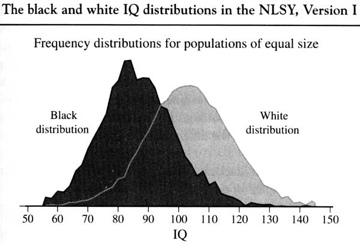
Go ahead, play with the curves
 Graphic credit: oplcnews.com

A note about race. I used to believe in races. Now I'm convinced by my research that there aren't races. The four racial groups are a convenient social classification that doesn't capture the biological picture. 

Humans can, do, and have interbred forever. However, there are regional differences that are best thought of as ethnic, not racial. For example, we have light-skinned, red-haired Norwegians, Somalis with narrow noses and dark skin, Siberians who are stout and built like furnaces, and lots of gradations and mixes. You can't draw dividing lines and end up with four distinct groups because there are transitions at the borders, and there are a hell of a lot of border regions.  

There is one human race, and we are all part of it. Welcome if you dare enter. . . but you are already here.

 Extras:
"But what comes out in the end is claims like this: you’d have to go through 5 or 10 times as many blacks as whites to find someone who’s mentally equipped to be a teacher or an accountant. I find that very hard to believe."
  • I can't tell if this blogger is a racial realist, as they call themselves, or not. However, he seems to know a great deal about European migration patterns. The net kicks up gems sometimes.
  • My followup to this post is here. Basically, I feel that I was wrong to argue against Derbyshire's conclusion (that blacks are inferior) and not attack the premise. If you've been thinking that as you read this post, I agree--I'm just late to that realization. (I also added those reminders on 5/24/12.)

Wednesday, April 11, 2012

My take on Derbyshire

I've been obsessed by the Derbyshire situation since it broke this weekend. Here is the most offensive quote in his smug, nasty post:
"The least intelligent ten percent of whites have IQs below 81; forty percent of blacks have IQs that low." -- [his link]
But that is just the point where the insults and inhumanity reached their peak. Derbyshire starts the piece by talking about "talk that most black parents give their teenage sons," then he produces a heartless, insulting lampoon of something painful that black parents have to do.

Though I'm not black, I've had such a talk with my son. He didn't have a girlfriend in high school, so we had "a talk" before he went to college. He's well-educated about sexual function, STDs, and contraception, but political-correctness might have kept the school from teaching him this: some girls will trap men by getting pregnant "accidentally." It's a hard truth that I wish wasn't, but I want him to know about it and be wary. So I told him. No, he hadn't heard that information before, so it was important that we had "the talk."

I know "the talk" isn't easy, so how incredibly insensitive of Derbyshire to use that as a vehicle to throw out advice to his kids to avoid blacks in public situations for their own safety. Then, he heaps on many other insults unrelated to crime statistics, such as the quote above. Finally, he closes with his envy of intelligent blacks who are in "high demand." But he doesn't express it that way. He says:
"To be an [intelligent black] in present-day US society is a height of felicity rarely before attained by any group of human beings in history." -- [his link]
I'm practically unhinged over this essay. I have a bit of familiarity with Derbyshire. A commenter in this blog linked to one of his posts. A couple weeks back I decided to read more. I didn't find columns, but I found his radio show ... for about 3 minutes until his pompous, time-wasting jabber became too much.

I have an aversion to a certain kind of high-class drawl that is soooo...    slooow...  and...   deliberate..    that it shoooows...  how serious...    and...    learned...    the...    speaker   is. I can't stand William F. Buckley speaking, or Gore Vidal, or Christopher Hitchens. Well, I found out that I can't stand John Derbyshire either.

So I need you, some of the readers here, to read Derbyshire's column and tell me if it's as bad as it makes me feel.


Please don't speak. (Gore Vidal)
Photo credit: newsbusters.org


Extras:  A list of words I used in describing Derbyshire:
  • offensive, smug, nasty, insults, inhumanity, lampoon, insensitive, envy, pompous, time-wasting, jabber, bad.
A list of words Derbyshire used in describing blacks:
  • cumbersome, the 'N' word, geniuses, morons, convicted murderers, investment bankers, hostility, more anti-social, a degree more anti-social, ferociously, inconvenience, harm, passively, racial solidarity, swamped, least intelligent, amulet, status marker, luxury good.
Derbyshire has been undergoing chemotherapy, which often has the effect of dulling cognitive ability for months. This certainly could be mitigation, since none of us humans are as good, smart, or diplomatic as we'd like to be when stressed with a profound illness. 

A different conservative response to Trayvon Martin. More on Derbyshire from Conor Friedersdorf and The American Conservative.

Monday, April 9, 2012

Zimmerman/Martin: This cannot end well

"It took a while to hit me, but I have a terrible sense of foreboding about this case. Zimmerman, at some point, will either be found guilty of manslaughter, or he'll be found not guilty, or charges dropped, or not even charged. Any outcome other than the conviction could ignite a huge cache of anger among blacks in this country."
That is white apprehension talking. This person fears the backlash from blacks more than he fears being in Trayvon's place. I know this because I wrote the quote--that's how I started this post, with my gut sense of foreboding.

I wished that wasn't the first thought that came to mind when I considered the future of this case. But then my thoughts shifted direction: what is it like if you have fear of disrespect or violence all the time, or on a regular basis? A fear that's always there, in your awareness or just below it. This is what it's like to be black in our society.

I suffered from mild prejudice when I was young, but little-to-none in the last 25 years. I've had a quarter century of freedom from prejudice, with very little anxiety about whether I'd be unfairly judged before I even had a chance to do or say something.

 Empathy Lessons
Just one time did I suffer some of the tension from prejudice. My family and I went to a restaurant in Mystic, Connecticut. We were seated, but no waitress came to our table, and they all avoided our glances. This went on 10 minutes, then another 5 minutes. Then I realized that they weren't going to serve us, but they weren't going to say so to our faces. The staff did see us leave, sheepishly. The sting wasn't erased at the restaurant across the street, though the service was friendly and efficient. For that 15 minutes, and for quite a while afterward, I knew what kind of anxiety prejudice can create--the nearly constant gnawing question whether you're going to have to deal with that shit today, or will it be a good day. If you start relaxing, the zinging pain when it happens again.

Some people seem to have no empathy for someone who has suffered from the prejudice of others. I wish they had to deal with it, so they would know what it feels like. People like Rush Limbaugh are probably  never on the receiving end, wondering if he'll be snubbed at the restaurant, or stopped while walking or driving. He's only in the dishing-out business, and business is brisk. Why worry about the saps at the receiving end?

Possible Responses
At this point, I want to pivot from a description of the problem to possible solutions. I think we've legislated what we can on racism. It's illegal to discriminate in hiring, promotion, access to public accommodations, education, rentals, and probably other areas I can't remember. I don't want to make it illegal to discriminate in personal actions and personal thoughts because I cherish freedom to say and do what we want so long as we don't violate the freedoms of others. And our freedoms don't include freedom from viewpoints we don't like.

What needs to change isn't our laws, but our personal lives. We need to evolve into a non-biased society as much as possible. This is happening, but at a pace that is set by the individuals in society, not by government. I think this is appropriate for the sphere we are trying to change-- the sphere of personal relationships. Maybe I'm too optimistic about people, but I also don't know a better alternative. But I'm listening if you have suggestions.

More harmony?
Photo credit: massnonprofit.org

Postscript: I started writing this before the Derbyshire explosion. I've read the essay. He has the same smug, self-satisfied manner that William F. Buckley had when he made his pronouncements on how people should behave from his comfortable, insular perch. Like Limbaugh, Buckley and Derbyshire never picture themselves on the receiving end of prejudice or misfortune.